A Project-Funded Job Offer: Test the Runway and Handover
A project-funded role can offer valuable work and a clear mission, yet the job title alone rarely explains the time horizon. Before accepting an NGO, CSR, public-health or development-sector offer in India, examine the contract, the project's remaining work and what will happen to relationships and records when the assignment ends. This is a practical decision test, not a prediction about whether funding will be renewed.
Separate the employment term from the project timeline
Start with three dates: the proposed joining date, the written contract end date, and the current project's scheduled end date. They may differ. The International Labour Organization's explanation of temporary employment includes fixed-term, project-based and task-based contracts, which may end after a specified period or event. That definition helps you ask precise questions; it does not replace the actual offer terms or local professional advice.
Ask the employer which entity will employ you, what event ends the contract, and whether an extension depends on a separate approval, funding decision or new project. Request the answer in the offer or contract. A hopeful statement in an interview is useful context, but it is not a confirmed extension.
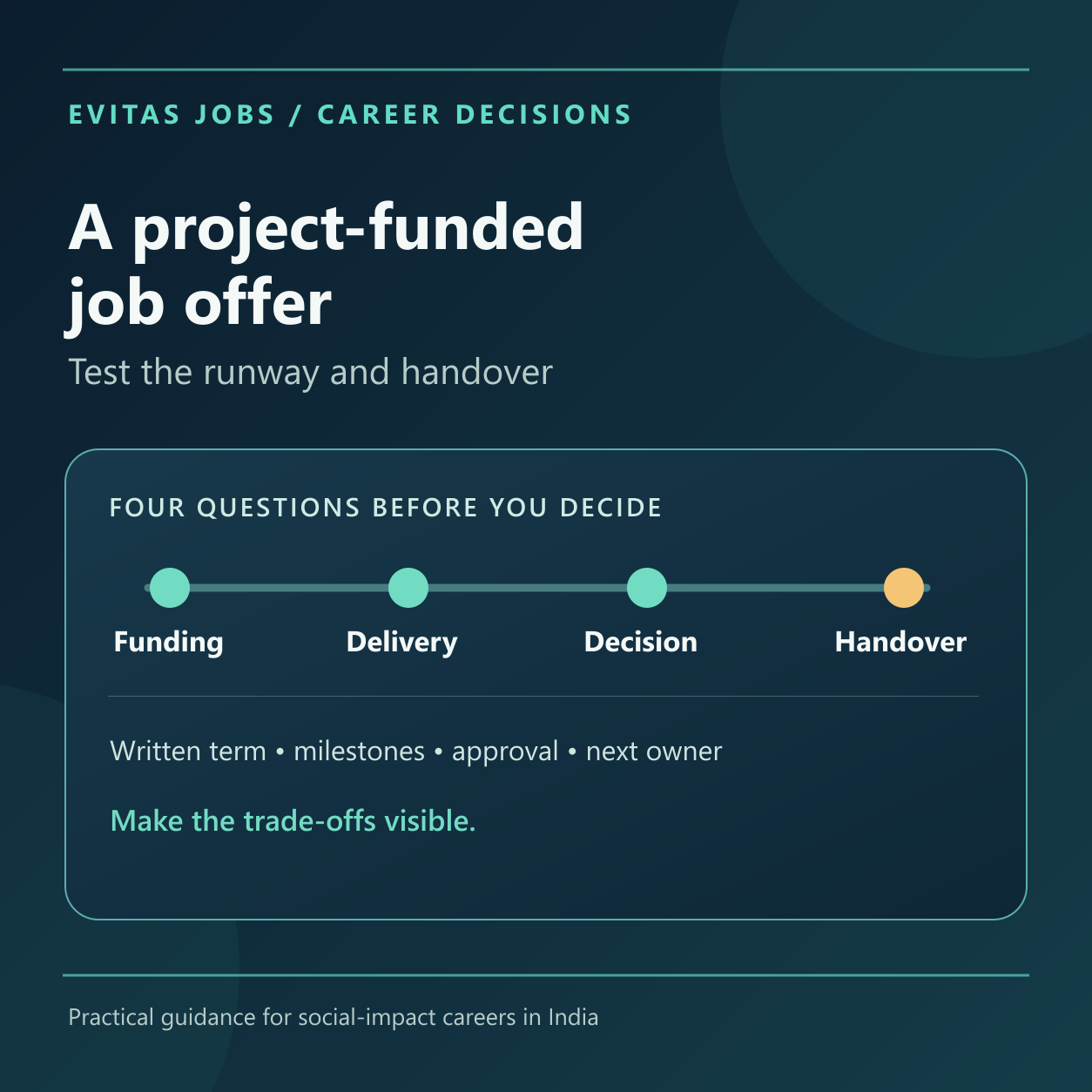
Build a four-part runway map
Draw one line for each of these: funding (what is committed for this role's period), delivery (what milestones remain), decision (who approves changes or a continuation), and handover (who will own the work afterwards). Mark each line confirmed in writing, explained but not documented, or unknown. An unknown is a question to resolve, not proof of a problem.
Use the map to distinguish a role created for a bounded deliverable from a role that carries ongoing community or partner relationships. The latter needs a credible transition plan even if the contract is short. The OECD's guidance on evaluating sustainability asks whether benefits are likely to continue and considers the capacities and resources needed for that continuation. Our runway map applies that question to a candidate's job decision; it is not an evaluation of a particular employer.
Worked example: a nine-month health programme role
Imagine an illustrative offer to coordinate a district health outreach programme. The contract runs for nine months, while community sessions and partner reporting are scheduled for ten. The hiring manager says a follow-on grant is possible, but no decision date has been set. Rather than treating this as either a safe or unsafe offer, the candidate asks four bounded questions:
- Which deliverables and travel commitments fit inside the nine-month paid term?
- Who authorises work and expenses during the final month of the programme?
- When will the continuation decision be made, and how will staff be informed?
- If the role ends on schedule, who takes over participant queries, partner commitments and records?
Suppose the employer confirms that the final programme month belongs to another team, names a handover owner, and provides a written contract end date. The candidate can now judge the offer on its actual nine-month terms. If the employer instead expects an undefined extra month of delivery, the candidate should ask for the scope and terms to be clarified before deciding. The example is fictional; it does not describe a current vacancy or employer practice.
Test the exit plan as carefully as the launch plan
Ask what must be handed over: stakeholder contacts, consented data, open referrals, unresolved complaints, reporting commitments, equipment and decisions awaiting approval. Discuss the process rather than asking to see confidential participant files. For humanitarian organisations, the Core Humanitarian Standard's resource commitments include adequate capacity to meet commitments and responsible resource management. Other social-impact organisations can use those questions as a prompt while following their own policies.
A useful handover has an owner, a date and an agreed destination for unresolved work. A document repository by itself is insufficient if nobody has authority to act on the information. Ask who can make decisions during a gap between contracts and how communities or partners will know where to go.
Make the offer decision on explicit trade-offs
Write a one-page comparison before you accept: (1) work you can realistically complete within the paid term; (2) skills and relationships you will build; (3) uncertainty you can tolerate; (4) financial and travel commitments you would carry; and (5) what you need confirmed in writing. Decide which questions are essential to acceptance and which can be settled during onboarding. This avoids turning every uncertainty into a veto while keeping material terms visible.
For an application or interview, you can show the same judgment constructively: “I would map the delivery milestones, decision owners and handover points in my first month.” Do not claim a renewal is guaranteed or that a short contract is necessarily a warning sign. EvitasJobs shares opportunities and career guidance; the employer sets the role, contract and recruitment terms and makes hiring decisions.
The takeaway
A project-funded offer is easier to assess when you separate the written employment term from the programme's ambitions. Map funding, delivery, decision rights and handover; ask for material terms in writing; and judge the role on the work and uncertainty actually offered.